4.30.2013

Building Blocks

Photo by Holger Zscheyge
Let's talk about toys. Why? Because that's where we all start. We grow up playing; some with dolls, GI Joe's, sand in the sandbox, even our food. We grow and learn by interacting with everything around us, probably even a few things out parents would not want us touching. Me personally, I grew up with building blocks. Then it was LEGO's and K'Nex and to honest I probably would still enjoy those today (ok I may still have a few left for a rainy day) but the fact is I grew up putting things together, and continue to enjoy doing so.

But as I've grown I've become fascinated with the concept of these mass produced goods. With a set amount of differentiated pieces and colors these toys allow for infinite possibilities; James May even used LEGO's to create a full sized house, granted the furniture does not look incredibly comfortable, but still (on a side note: if you haven't watched the show Top Gear check out these 10 clips, yes it's about cars but trust me it's not about the cars). Anyways, mass production is used to create most of the products we buy but these products that when used in mass to create unique structures/objects is something that I find fascinating and is one of the main reasons I find the design/architecture profession calling to me.

So let's look at a few of these grown up versions of these childhood toys. First up CMU:


This project above was created by a nursery and patioscaping company called Potted. I wish I could find the original blog entry from 4 years ago but here is more from apartmenttherapy on the project. This was created using just 12" concrete block (a little different then your standard 8" construction CMU but mass produced building product none the less). I've been looking into CMU for a future project of mine and may look at this for ideas. I can see something like this becoming a full scale living wall eventually but for now it's nice backyard planter project.

Next up brick:

Photo by NADAA
This project I show above is the Tongxian Gatehouse, a project from Office dA now NADAA and was the first thing I thought of when creating this post. Besides the brickwork the project is amazing as well.

Brick is one of those amazing products that I look forward to working with more. We normally see it as a pretty standard straight forward building material but when it goes out of this realm into a dynamic part of a building it is something special. Here are a few more examples for your viewing pleasure.

Image courtesy ming3d.com
An amazing student project using a robot arm. Check out the blog post here. There is also a cool video with what looks like they take the robot arm on the road to build a similar structure. There will be future posts on robots and architecture but for now let's just look at this beautiful wall.

Image courtesy dezeen
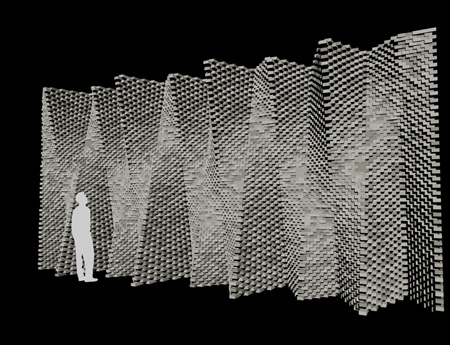
Finally another theoretical student project called Brick Tectonics by Ricardo Ploeman popped up on dezeen in 2010. I'm hoping this project is eventually brought to life but for now we can just look at some of the fun dezeen Ploeman created.

Finally let's look at wood:

Photo courtesy simonov
I think wood many people have a natural appreciation for unlike brick and CMU because it is a more naturally beautiful material. The grains differentiate from piece to piece making each piece of lumber unique, but today we still mass produce this material into 2x4's, 2x6's, flooring slats and 4'x8' sheets of plywood. The standardization of their sizes have allowed us to quickly and cheaply build our homes, businesses and products. Now I'm sure many of you have seen wood used in pretty standard ways, cabinetry, flooring, tables, ect. but here are a few products/structures/designs that use the multiplication of standard sizes in unique and exciting ways:

Photo courtesy picornot.com
This is a project by Maya Lynn called Systematic Landscapes (yes the one that did the Vietnam Memorial) that she did at the Museum of Contemporary Art San Diego. It uses just 2x4's but as you can see she creates this mountainous landscape from repeating the pieces cut at various lengths. There is also an interesting photo album of it's construction you can see here.

Photo courtesy Everitt & Schilling Tile
This wall was created by tiling many pieces of wood together. The Everitt & Schilling Tile Company has a variety of wood products that grasp this repeated wood pattern and have created a number of different wood tiles. What I like about these products is that they capture the beauty of a repeated mass produced item and have created a product that any handyman/homeowner can install without having to cut down thousands of pieces of wood to fit on their wall. Check out their website for other products and great photos.

In conclusion, this idea of using mass produced products to create fun and unique designs is something fascinates me and continue to look for inspiration for my own designs. The idea that you can use limited styles of LEGO bricks to create a house or a bunch of 4x4's to create a unique wall design is something that I think goes under-appreciated outside of design and bringing this kind of thinking to the masses is something that I hope to instill.

4.24.2013

Architectural Objects

To follow up my last post of architects designing actual products I want to look at architectural objects. What's the difference? The architectural object looks at how just the scale of a object can complete change its usage, or perceived usage. Let's go back to one of my first projects in school.

Phase one of the studio was to make a lamp. So here is what I made:


The center I made out of concrete with two halogen lamps (probably a little too much for the size of this thing). But to put this at a scale it was about 24"W x 16"H x 8" D. What I was looking at was how light effected its surroundings. I created large transparent striated pane out of acrylic and then moving plans coated with color paper. As I slid the colored panes over the areas where light was emitting different colors radiated outwards to the walls. Now how did this transform into an actual building?

The image I created simply by photoshopping images of my project into a space at the size of a building. See where I'm going here? The change in scale changed how this lamp is perceived. Now this is just a lamp still so the final step was to create a building from this lamp.


Please forgive these images, they were certainly not my finest renderings but from one of my first studio courses. And a section for further enjoyment.


Now this is just one example from my projects.

The reason I bring this up is because a recently completed project by MAD.


This is the China Wood Sculpture Museum in Harbin, China. Now this is a full scale, built project around 600 ft. in length, but can you imagine it at the size of a normal piece of wood? I'd say that MAD is probably one of the most prominent architectural object firms I've seen recently. Other works like their Ordos Museum or their Superstar specifically look into this idea of the architectural object. Can you not see the Superstar hanging off of your Christmas Tree?

What other pieces of architecture can you see being placed on your table or used as a bench in the park?

4.22.2013

ArchitectDesign Products


Finally! I found a great post from ArchDaily about some interesting architect designed products at Milan Design Week. This is something I was very excited to see being someone pursuing both architecture and product design. Some of the products look pretty interesting others not so much but I'm just happy to see some content outside of individual architects websites about their products be posted.

So lets dive in take a peek at some of these objects. I'm just going to talk about a few that spark my interest and you can read the full post from ArchDaily here.

What is pictured above is from OMA's Tools for Life product line. What is it exactly? It's clearly three beautiful horizontal bars. That move! They rotate off axis to form whatever the user wishes these bars to be: a shelve, a seat, steps, light (that's right they light up too!) Pretty cool and along the same lines of my interest in personal customization. Will we ever see these on display at the local Target I highly doubt but I guess were designed to be manufactured for Knoll, Inc. The other pieces other than the coffee table are nothing special but feel free to check out the line here.


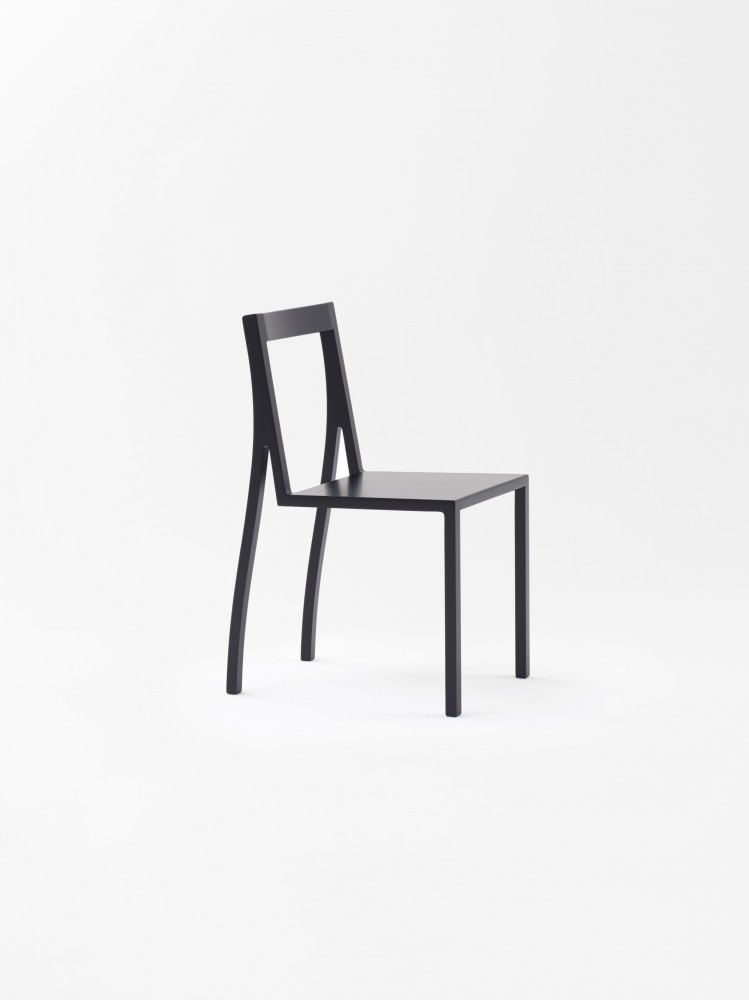
Next up is this chair by nendo, a smaller Japanese architecture firm. What I really like about this minimalist design is not that fact that there is no back on the chair (looks not completely comfortable) but how the back legs reach up and hold the chair along it's back rather than the joint between the back and seat. It is a subtle move that makes the chair stick out to me. It's simple, but there is so much more there, at that non supported joint, holding on for dear life by it's thin vertical supports. The chair is struggling to hold itself up but looks as if it's is lighter than air. Really well done.


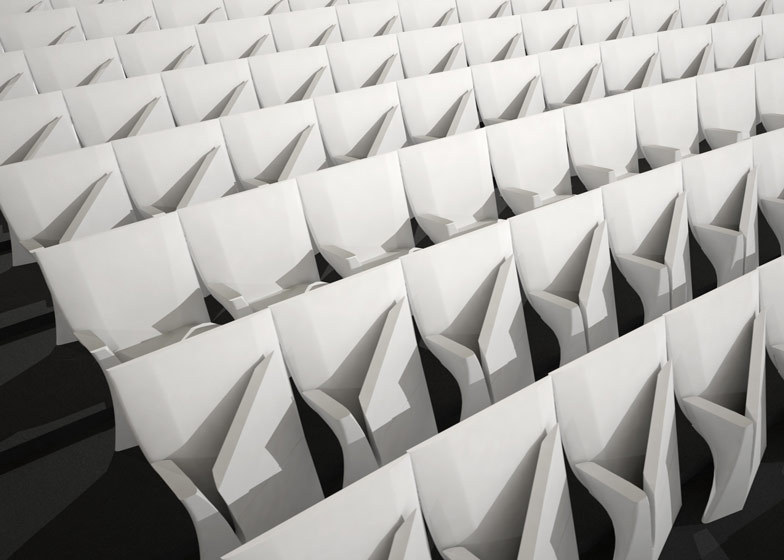
Finally let's check out the third contestant Zaha Hadid's auditorium seating. I may not be the most loving critic of Zaha's architecture but she makes some really interesting architectural objects. This may just be a rendering but they look amazing. What I really love about these seats are their asymmetry. Now most people may say that they prefer symmetry, in fact our brains are programmed to love symmetry (fun fact: we find my symmetrical faces more attractive) but there when it comes to architecture and design symmetry it reminds me of classical European buildings or our capital buildings; large baroque, overly ornate buildings that are great for their time and symbols of power but just not attractive in todays world. These chairs, in their asymmetrical form and repeated for an auditorium just seem to work. Now let's just hope in reality they can function.

4.21.2013

The Creative Type

So this article was recently published in the Harvard Business Review called "Seven Rules for Managing Creative People" later changed to "Seven Rules for Managing Creative-But-Difficult-People" by Dr. Tomas Chamorro-Premuzic. I found it quite interesting and definitely noticed a few parallels between the Dr's thoughts and my own way of thinking as a creative type. After reading it I was checking out a lot of the comments, most of which were very negative, and likely from creative people as well. Now I don't share all my views with what this article points out but thought I would comment on it and hopefully take some of it's ideas into consideration for managing a design based business.

I think one of the biggest problems people had with this article is that he wrote many lines in it generalizing creatives and many took it too literally. I think many of his one lines like "

Let's start with #1: "Spoil them and let them fail"

One problem I had with this whole article was that some of the titles for each section were more of a way to grab the reader than actually represent what the author is trying to say, however this heading seemed appropriate. Creative people, just like many of a firms employees, need encouragement and support. Letting them think outside the box without the disruption of a negative attitude I would certainly agree fosters innovation that any company, large, small, or especially a start up needs to compete in the market. In fact innovation is probably the leading force in creating and maintaining a successful business.

#2: "Surround them with semi-boring people."

Many creative minds can be pretty egocentric, that's not to say all are. This one was criticized widely saying that some of the best ideas have come through collaboration of many creative minds. To me, this one has two equal sides.

On one side, there are those creative leaders, that their vision is the only one and it is difficult changing course. My personal experience with this has been working for an architecture firm, where the main architect sketched up his ideas and passed it down to a draftsman (usually me) to draw up the plans and make it structurally work. Now that's not to say I'm not a creative person, which I would say I very much am, and many of these rules I would tend to agree with and there were certainly times where my boss and I clashed. However, I knew my roll as an employee and my bosses personality type so I sometimes rolled my eyes but just did as he asked to avoid conflict, and in reality he was the one who knew and was working with the client so I presumed that he likely knew better than I what the client was asking for.

This type of situation is likely very similar to many creative offices. Here the creative type in a more leadership role is likely to want his vision carried out over another employees and to him/her these "semi-boring people" are there to carry out their ideas. These employees may, even very likely are, the creative type themselves, they may be like me and roll their eyes, do their best to carry out what their boss had asked, but have their own ideas too. From experience when there was something that I felt really needed to be changed I just did it and explained to my boss my decision. If it was a small enough thing that didn't interrupt or still followed "his" design, it usually was accepted with little fanfare.

On the other side though there have been know to be great collaborations between creative types that have made amazing work. Musicians collaborate all the time (ever seen a song "featuring" another artist?) artists, architects, marketers, even engineers collaborate with one another. These collaborations usually are crosses between these many creative types; the artist Ai Weiwei (who by the way has many employees that are also artists) and architects Herzog & de Meuron teamed up for the 2012 serpentine pavilion; engineer Cecil Balmond teaming up with OMA to create the CCTV Headquarters in Beijing; Jack Bruce, Ginger Baker, and Eric Clapton teaming up to create Cream. These collaborations are not uncommon, and as you can see have created great outcomes.

So this is why this rule has led to controversy. In an office setting where there tends to be a leadership role, that leader can often want to carry out his vision and the "semi-boring people" help to support and mold that vision into a tangible thing whether it be architectural drawings, a marketing plan, or a large artist installation. In other cases where roles are split between creative types this can be very beneficial to the final product. In the CCTV Headquarters, Cecil Balmond was responsible for the design of the structure and it's engineering, while OMA were the architects in charge and designed the overall form of the tower. I think if both OMA and Cecil were in charge of design the outcome would be completely different and likely clashes in personality/vision would create a less impressive project.

#3: "Only involve them in meaningful work"

This rule likely applies to more than just the creative type. I would say many people want to feel like their work has meaning or is larger than just the task at hand. Personally, for me what leads to my best work is passion. Working for someone else and carrying out their vision certainly does not make me excited to go to work every day, but talk to me about my own designs and I'm hooked. Passion is what drives the creative type and if they are not passionate or feel that their job is not meaningful to a larger picture they lose interest. Passion leads us to staying up all night trying to solve the problem rather than pack it in at 5pm, it drives us to fight with our own professors over what their project means (I have see break downs in school over this). Not only the creative type but entrepreneurs have this same passion, it gives them the ability to take the risk of starting something of their own.

Passion leads to humanity's best, and maybe worst is some cases, but certainly the creative type is extremely driven by his or her passion for their work.

#4: "Don't pressure them"

Coming from an architecture background where deadlines are always an issue pressure is constantly being placed on me or my bosses by clients to get things done fast. And it likely has had an inverse affect on the work coming out of the firm. The author says to let creatives not follow structures or processes or ask where they are or what they have been doing. Now, I agree the creative mind tends to work best when it is free to think without many constraints but from a business aspect sometimes a little structure is needed to stay focused and create communication between the creatives and other parts of the company. However this rule I would say goes in tandem with rule #3. If someone is passionate about something they will likely be pressuring themselves to solve the problem, finish the project, or make the product. Passion leads to self motivation.

#5: "Don't overpay them"

This one probably led to the most controversy. No one likes to be told that they are overpaid or should be paid less, and thus many were upset. Another poorly worded title but I have to agree with the main idea: money is not a driving force for the creative type. This also goes with the idea of passion. A creative person likely will do whatever it takes to get his/her vision perfect, not because they are getting paid to but for their own sake. Now if that's combined with a vision of profitability that can lead to a great business but many times money is still not the driving force to stay up all night. Some of the greatest products, services, businesses were created by people that believed in the idea not it's profitability, and the best businesses instilled this idea into their customers, making them as loyal as ever. I'm looking at you Apple.

#6: "Surprise them"

I completely fall into this category. I am always seeking change and the phrase, "They take a different route to work every day, even if it gets them lost, and never repeat an order at a restaurant, even if they really liked it" struck awfully close to home. Now I wouldn't say I normally get lost on my way to work but certainly will take different routes places just for the enjoyment of seeing a different setting. I would also say that many other creatives are the same way, at least from my personal experience. Being naturally curious about our world leads us sometimes to wander. Change is good to us creatives and it also leads to amazing innovation.

#7: "Make them feel important"

Duh. Who doesn't like to feel important? I think almost everyone is searching for some meaning of importance in their lives. This goes for both the extrovert talking up a storm asking for attention and the introvert quietly sitting doing their work in the corner. One may just be a bit more obvious that they want to feel important. This goes back to rule #3, where to the creative meaningful/innovative work is important to them and recognition or a display of how it is important is necessary to keep creatives motivated for the next problem.

The authors final words here also got a lot of outcry, "even if you are able to manage your creative employees, it does not mean that you should let them manage others."In particular people called out his reference to Steve Jobs. I found that interesting because I am currently reading his biography by Walter Isaacson where it talks about his management style. Many of his employees found him very difficult to work for, he yelled, was irrational, stole others ideas claiming them to be his. What he did though was instill an idea that not only did Apple create powerful products, but it created beautiful products, and that the inside was equally important as the outside. His vision is what drove his employees to do their best work but was likely not the best manager. This holds true for many entrepreneurs who's passion is what drives employees, not their management. Many start ups as the author states tend to plateau because these innovators were left in charge to manage rather continue their job and innovate, what many people don't realize is that Apple became so successful because Jobs, while he did manage people, also was never in charge of managing the whole business. Originally Mike Scott was brought in as president and later on Tim Cook would be brought on to manage the multibillion dollar corporation allowing Jobs to carry out his vision for how people would connect with their world.


4.15.2013

Great Architects Discuss Inspiration


Architectural inspiration is a strange thing. There are many different schools of thought dedicated to how a buildings form should create itself; whether we go back to Peter Eisenmann and Superstudios infinite grids; Rem Koolhass and his use of program to create form; MAD and their architectural objects. Inspiration can come from infinite places, no one is right or wrong (hence why debate continues) but I'd say that this is beneficial to the practice. Lively debate over form or program is what architects, student, and professors are constantly discussing at critiques, at their desks, or over a cup of coffee with a coworker. I bring this up because I wanted to share a great series of TED Talks about architectural inspiration.

My blog earlier about the grid falls into this category of "inspiration". The grid I certainly would not say is my main focus but one of many. Architects and designers usually spend their entire careers developing their own inspiration and it constantly changes but here are a few great architects of our time discussing theirs on a variety of projects.

Enjoy

4.10.2013

Why travisDesign?


Why travisDesign? One thing I've started to learn about this whole start up business is self branding. Selling yourself. A simple yet often underutilized tactic that will open up business  opportunities, help land that desired job opening and help focus you in building you into someone people wish to purchase from or hire on. I chose travisDesign as a name that has multiple meanings to help in this process. First "travis" that's my last name of course. Second "Design" it's what I do, not just that but it is my personal passion and what I continue to educate myself in. These two combined of course create my company/brand's name. It also is a call out to my initials DT, a combination I biasedly am fond of and help to form the logo at the center of the name and finally a call out to my rapper name travisD. I may not be a rapper but you know, everyone needs a good street name. What's yours?


Like I said in my first post, I want this blog to be about design, architecture, and the business of design. Branding is a major part in all these ventures. The greatest architects, "starchitects" as they're best known, have built up names for themselves not  by just doing great work (some I am not even a huge fan of) but are controversial, outspoken, go beyond the built world of architecture and delve into it's theory. They question the profession and push the limits of construction, and sometimes the wallets of their clients. Rem Koolhas, Byarke Ingles, Zaha Hadid, Thom Mayne, etc. aren't famous from their work alone, but have established a name for themselves inside and outside of the profession as visionaries through their self branding.


I'm no expert on self branding but I'm here to discuss my experiences as they have started to begin down this new path. The blog is an open forum for those that want to discuss this more and share insights.

Inspiration: The Grid

Blog post #2. Getting deep. Inspiration: The Grid


One thing I've learned is that many architects and designers love the grid. The grid being an infinite pattern of squares or rectangles that continues beyond the page, beyond the city, covering the globe. The grid is a great way to navigate, measure, organize, create uniformity, etc.. There have been dedicated studies, entire architecture practices dedicated to the grid. Works by Peter Eisenman, specifically House II, House VI, and House X; Superstudio's images of the endless monument; le Corbusier's Plan for Paris; work with the grid, work off the idea that the grid is completely equal, there is no beginning, there is no end, it is infinite and ever expanding.

Superstudio probably has done some of the most theoretical work on the grid and you are welcome to go deeper into their thoughts here. If you aren't all that interested about all that theory but would like to my quick thoughts, read on.

The grid today is present in many of our lives. The buildings we work and live in usually are held up by a grid of steel columns, the city blocks of modern cities like New York and Chicago are composed of a basic grid. Even the apps on our phones or desktops are arranged by an invisible grid.

It is used in many of these ways because it is economical, reproducible, great for navigation and understandable. What amazes me is the variety, customization, and uniqueness that the grid allows. New York is a perfect example of this. North of Houston, the grid makes up the city streets, the avenues running east to west and the street numbers running south to north. However each of these rectangular blocks is composed of such diverse buildings/people/views/foliage/businesses.

These idiosyncrasies of spaces created by what appears to be a completely repeated, uniform grid fascinates me. It has led me to ask, how do we stick out in a world full of repetitiveness? How do we find uniqueness in the grid? What are this systems capabilities and limits? Can we use the grid in other ways in our lives?

To clarify, the image above is a snapshot of part of my hometown, Detroit. Probably best know in urban planning circles for it's "Hub and Spoke" plan by Augustus Woodward is still well dominated by the grid.